The problem with blinking
Today's best optical lattice clocks work in cycles: capture and cool a cloud of strontium atoms, load them into an optical lattice, interrogate the clock transition, read out, and start again. While new atoms are being prepared, the clock laser is on its own. It has to rely on its ultrastable reference cavity to remember the frequency until the next batch of atoms is ready. This dead time costs precision twice. Laser noise during the gaps leaks into the measurement (the so-called Dick effect), and the clock's instability averages down only slowly, as one over the square root of the averaging time. A clock that measures without interruption can, in principle, average down much faster, as one over the averaging time. Reaching a given precision could then take minutes instead of hours, provided the atoms give enough signal, which means a high atom flux.
Our approach
Our zero-dead-time clock is a passive clock: a laser probes the atoms, and the atoms tell the laser how to correct its frequency. Its sibling, the superradiant clock, is an active clock, in which the atoms produce the light themselves. The zero-dead-time clock is fed by a steady-state source of ultracold strontium, the technology our lab developed on the way to continuous Bose-Einstein condensation. Atoms from this source are distributed over several interrogation zones, so that at every moment at least one ensemble is watching the clock laser.
The ensembles have different jobs. Some are cycled quickly with short Ramsey times. They have a large capture range and keep the laser locked to the atoms, but with modest precision. Others use long Ramsey times for high precision. Long interrogation is only possible because the fast lock has already pre-stabilized the laser, so the precise ensembles never lose track of which fringe they are on. Interleaving two independent atomic systems to remove dead time was demonstrated by the Ludlow group at NIST (Nature Photonics, 2017). We want to bring this idea together with a continuous atom source in a single apparatus.
Why it matters
The zero-dead-time clock is part of the QDNL quantum sensing testbed. It is designed to become one of the strontium clocks that provide a local optical frequency reference for the Dutch hub of the European time and frequency network, which we are building in the same lab as part of the Time & Frequency Application Line. In other words, this clock will not just tick for us: its signal is meant to travel through optical fibers to other labs and institutes.
Status and team
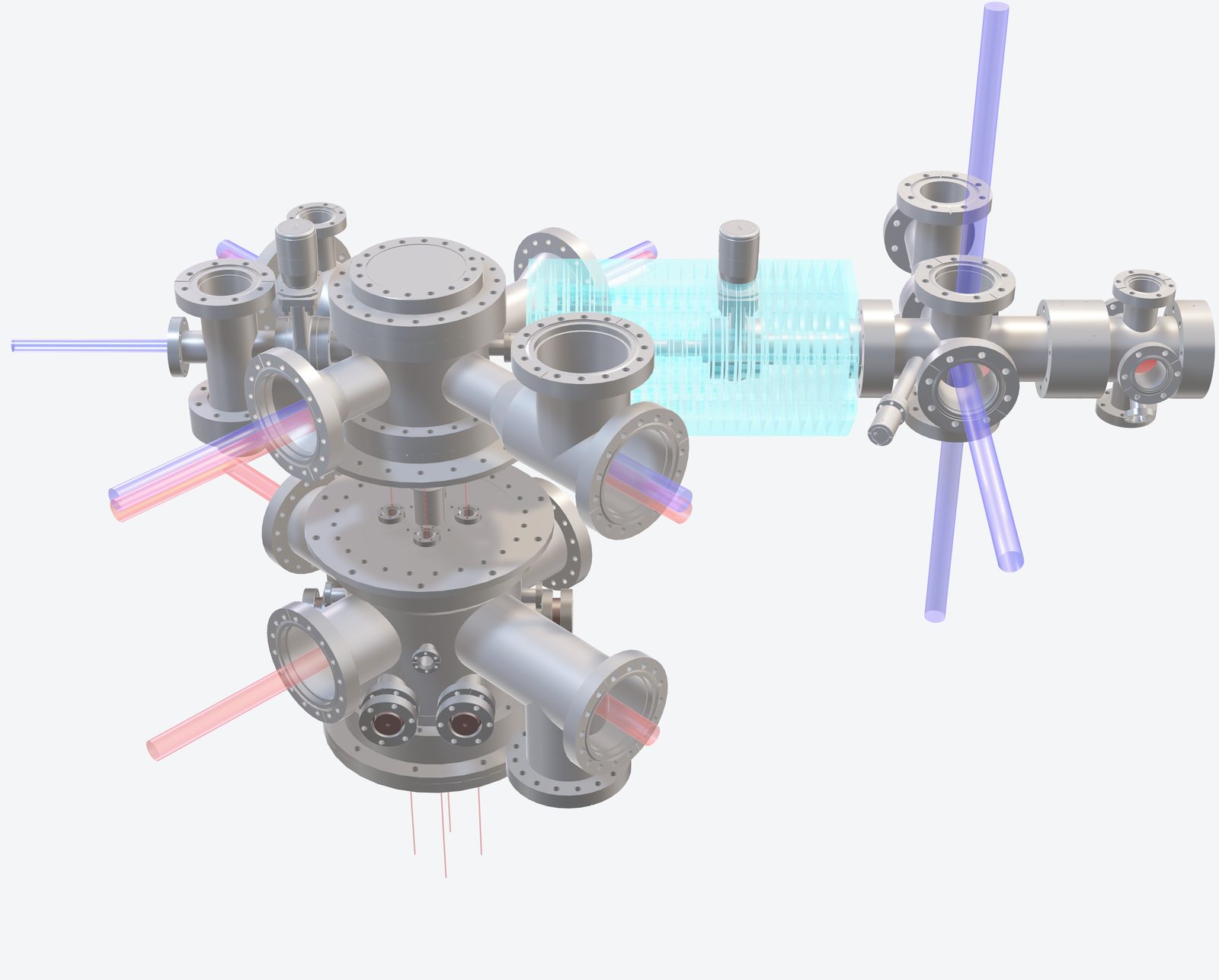
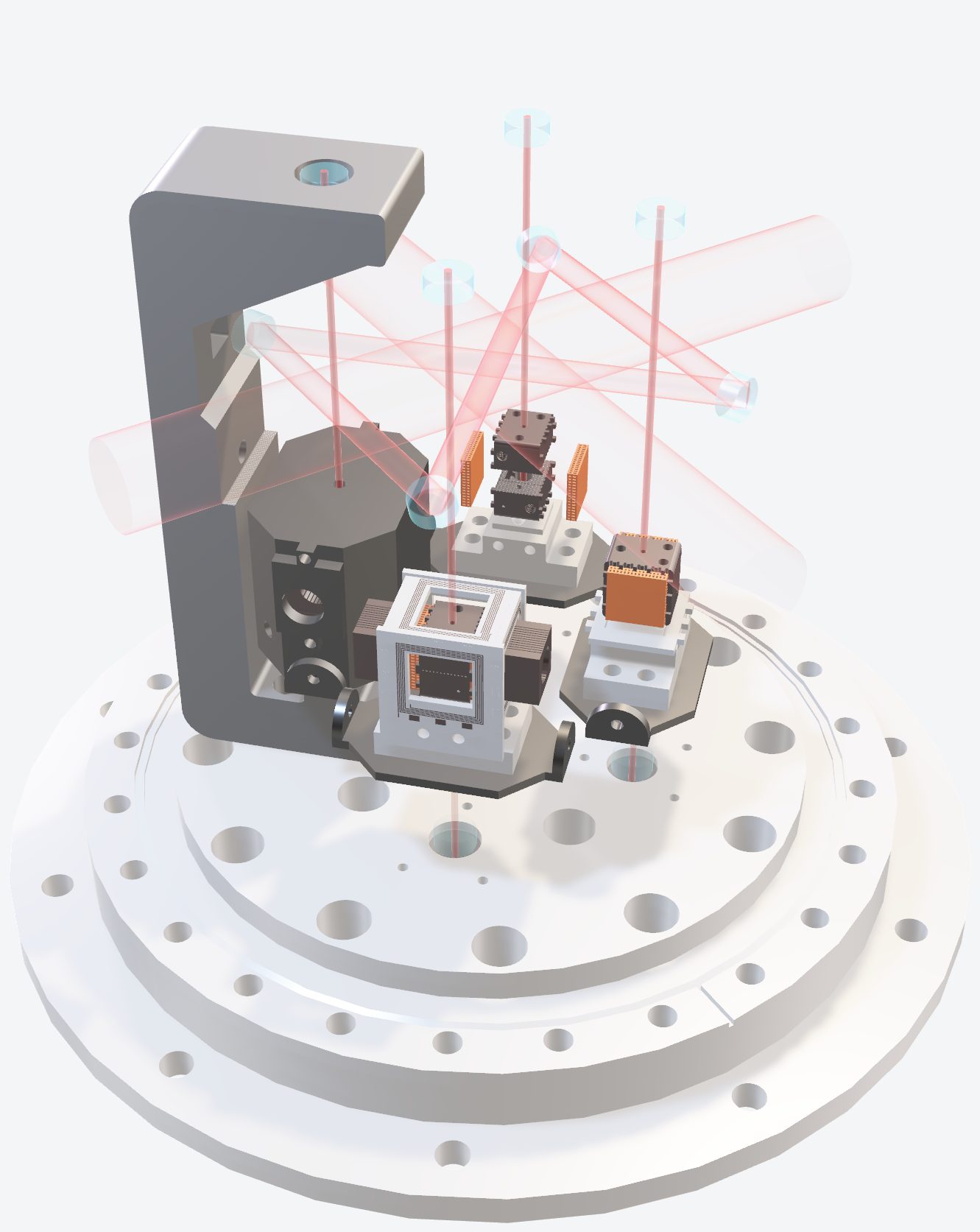
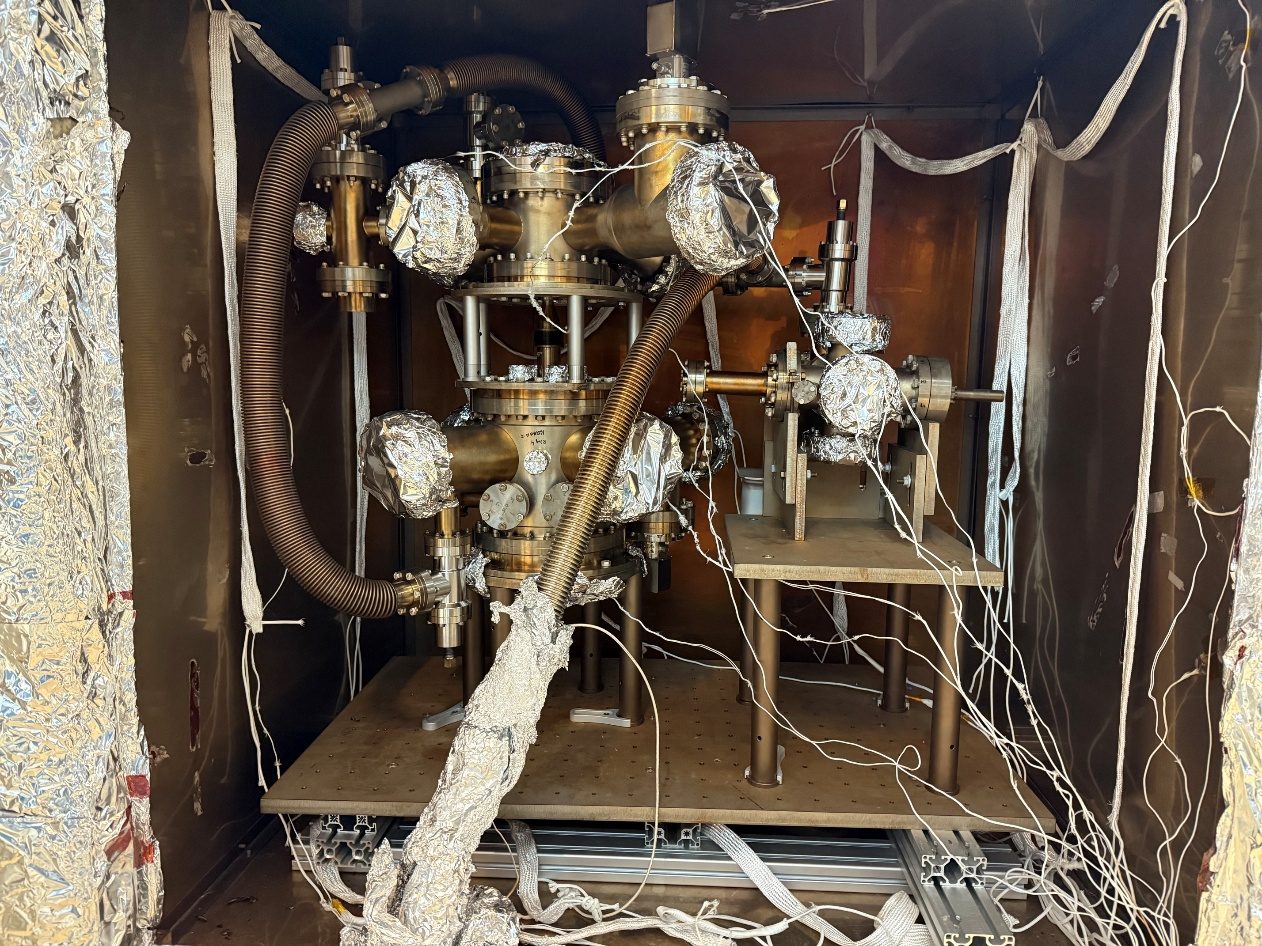
The clock is under construction. The vacuum system has been assembled (see the photos and design renders in the gallery), and the team is setting up the lasers and optics around it. PhD students András Gácsbaranyi and Benoit Brouillet and postdoc Sumit Sarkar make up the team. Building a clock from scratch means that you see every part of it: vacuum engineering, lasers, optical setups, electronics, control software and, finally, the atoms. Because the team shares lab D0.135 with the time and frequency link, frequency combs and fiber links are never far away.
Interested in joining? Have a look at our vacancies.
Gallery