The first strontium BEC
Strontium is an alkaline-earth element with two valence electrons. This gives it properties that the alkali atoms of the first quantum gas experiments lack: a ground state without electronic magnetic moment, long-lived metastable states and very narrow optical transitions. These properties were already used for optical clocks, and proposals were appearing to use them for quantum simulation and quantum computing. What was missing was a strontium quantum gas.
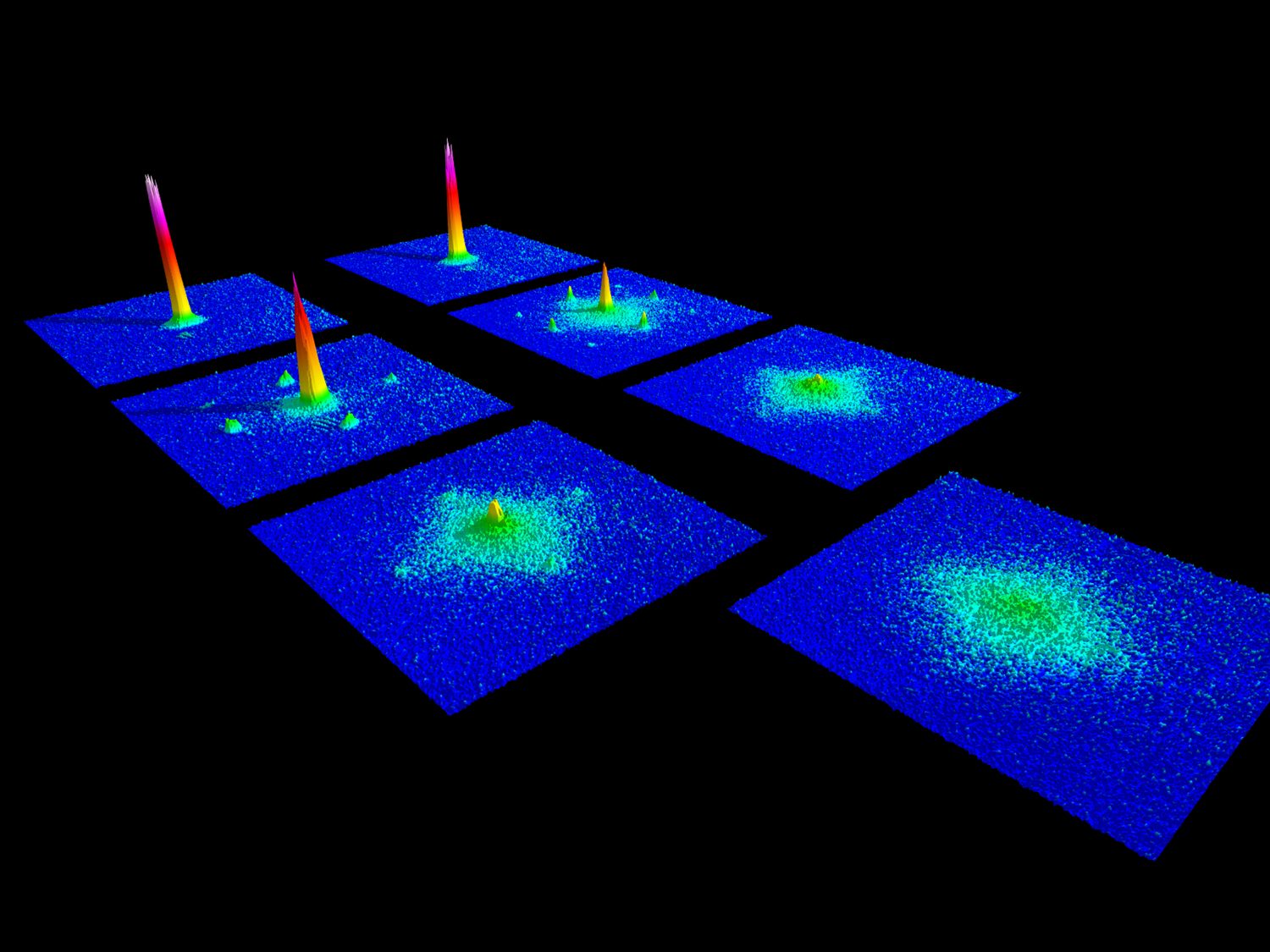
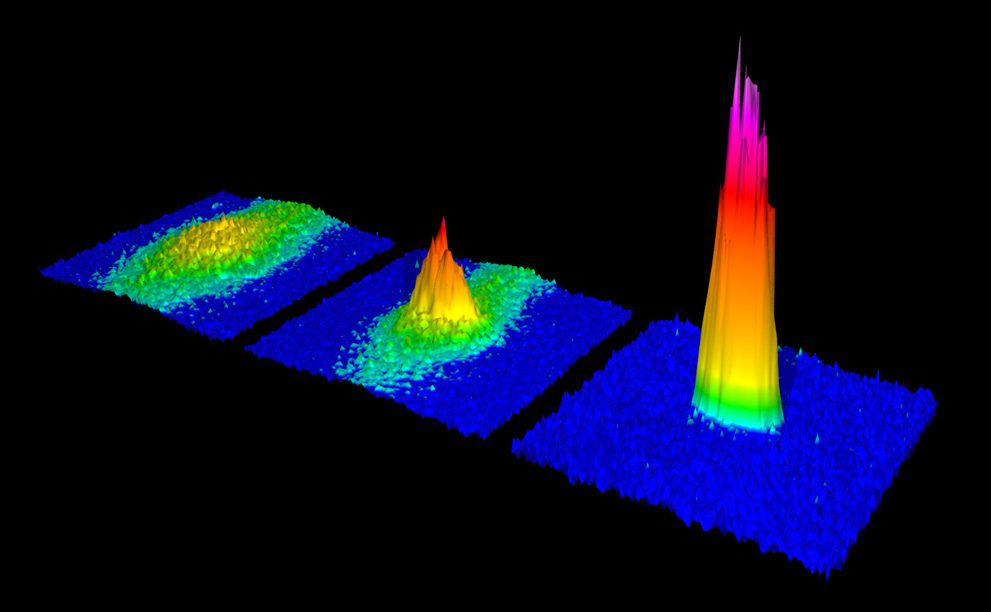
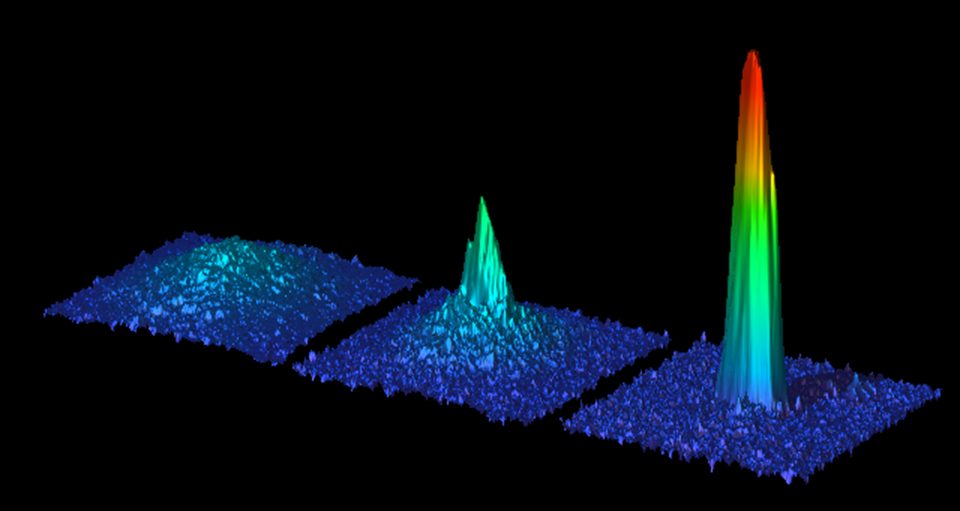
The SrBEC project started in 2008 at the Institute for Quantum Optics and Quantum Information (IQOQI) of the Austrian Academy of Sciences in Innsbruck, in collaboration with the group of Rudolf Grimm. In September 2009, just 17 months after starting in an empty lab, the team created the first strontium BEC, almost simultaneously with the group of Tom Killian at Rice University. The trick was to use the rare isotope 84Sr, whose scattering properties are well suited for evaporative cooling: a pure condensate contained 1.5×10⁵ atoms.
Quantum gases of every kind
The years that followed explored what strontium quantum gases can do:
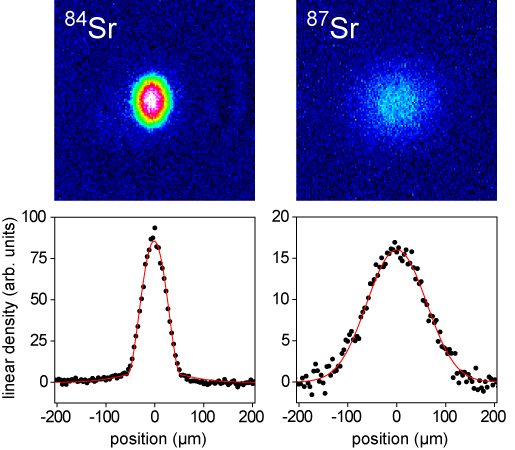
- A double-degenerate Bose–Fermi mixture: fermionic 87Sr, with its large nuclear spin of 9/2, cooled to quantum degeneracy together with a 84Sr BEC.
- A BEC of 86Sr, despite its large scattering length of +800 Bohr radii and strong three-body losses.
- Detection and manipulation of the ten nuclear spin states of 87Sr, separated by an optical Stern–Gerlach technique.
- The superfluid to Mott-insulator transition of 84Sr in an optical lattice.
- Ultracold Sr2 molecules in the electronic ground state, created from atom pairs in an optical lattice by stimulated Raman adiabatic passage (STIRAP), a method that works without magnetic Feshbach resonances.
- “Larger, better, faster, colder”: 84Sr BECs with more than 107 atoms, BECs with a cycle time of only 2 s, and deeply degenerate Fermi gases. The paper thanks Daft Punk for their motivating music.
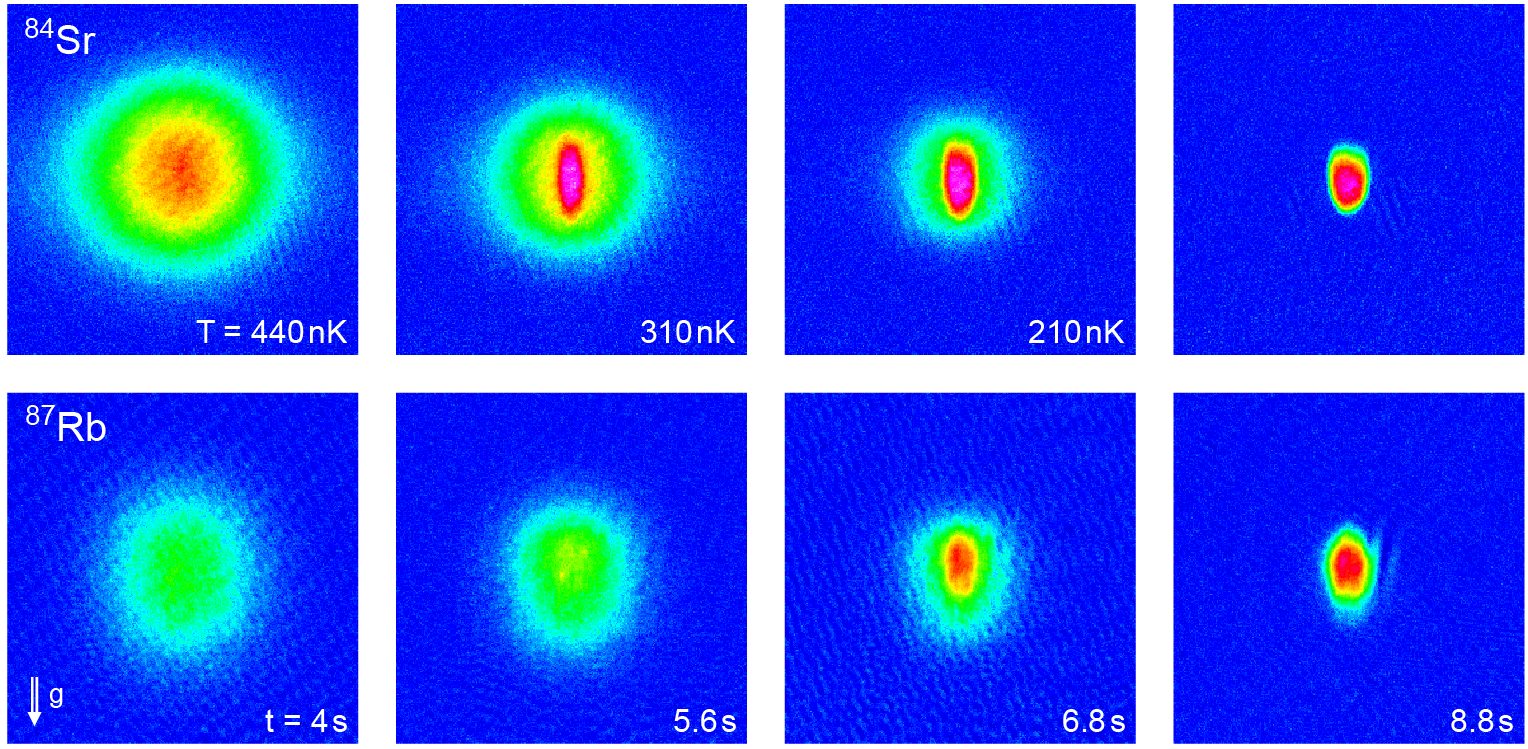
- Double BECs of strontium and rubidium, using sympathetic narrow-line laser cooling of Rb by Sr, a first step towards RbSr molecules.
- Reservoir spectroscopy of about 70 lines of two repumping transitions.
Laser cooling to quantum degeneracy
Since the first BECs in 1995, every condensate had needed evaporative cooling. SrBEC showed that a BEC can be created with laser cooling as the only cooling mechanism. A laser-cooled reservoir of atoms surrounds a small, dense dimple trap, where a “transparency” laser beam protects the atoms from the cooling light; a BEC appears in the dimple within about 60 ms. Physics World selected this result as one of its top-10 breakthroughs of 2013. It also contained the seed of a new machine: the same idea is at the heart of the continuous BEC achieved later by SrPAL.
From Innsbruck to Amsterdam
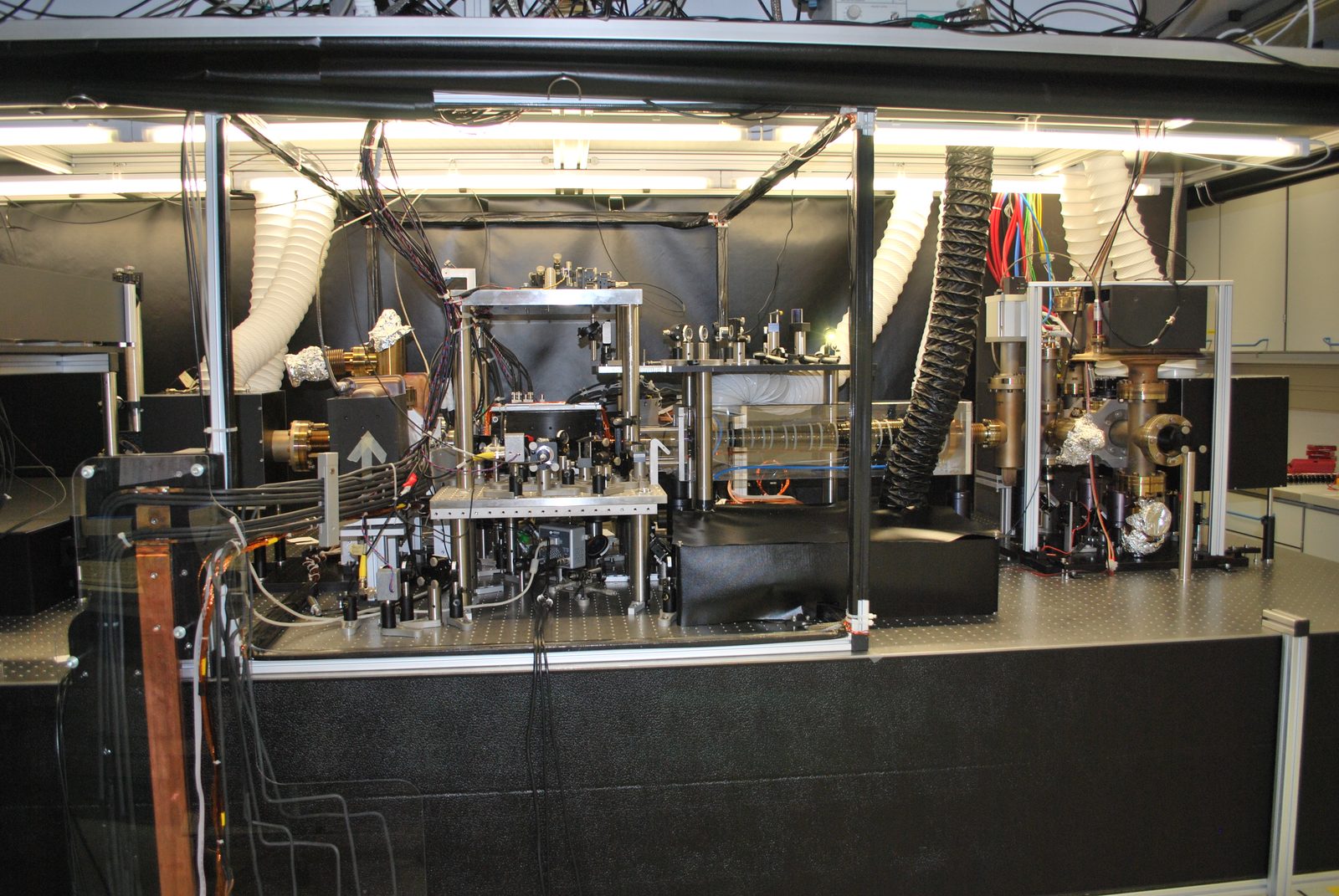
In December 2013 the machine moved from Innsbruck to Amsterdam. It was rebuilt there and continues to produce results as the RbSr experiment. The Innsbruck team consisted of Simon Stellmer, Meng Khoon Tey, Bo Huang, Florian Vogl, Mark Parigger, Alex Bayerle, Slava Tzanova, Benjamin Pasquiou, Rudolf Grimm and Florian Schreck. The project was funded by a START prize of the Austrian Science Fund (FWF), the Austrian Ministry of Science (BMWF) and the iSense FET-Open grant of the European Commission.
Gallery