OpticsFoundry
Our spin-off makes bonded optical circuit boards for quantum technology
Optics as a circuit board
Every cold-atom experiment has a laser table covered with mirror mounts, posts and screws. Each mount is a degree of freedom that can drift, and rebuilding a setup costs weeks of a physicist's time. Electronics went through the same phase long ago, before printed circuit boards made it possible to design a circuit on a computer and receive a reliable, reproducible board a few weeks later. OpticsFoundry B.V., a 2025 spin-off of our lab, wants to do the same for optics: it should be as easy to design and receive an optical circuit board as it is today to design and receive an electronic one.
How the boards work
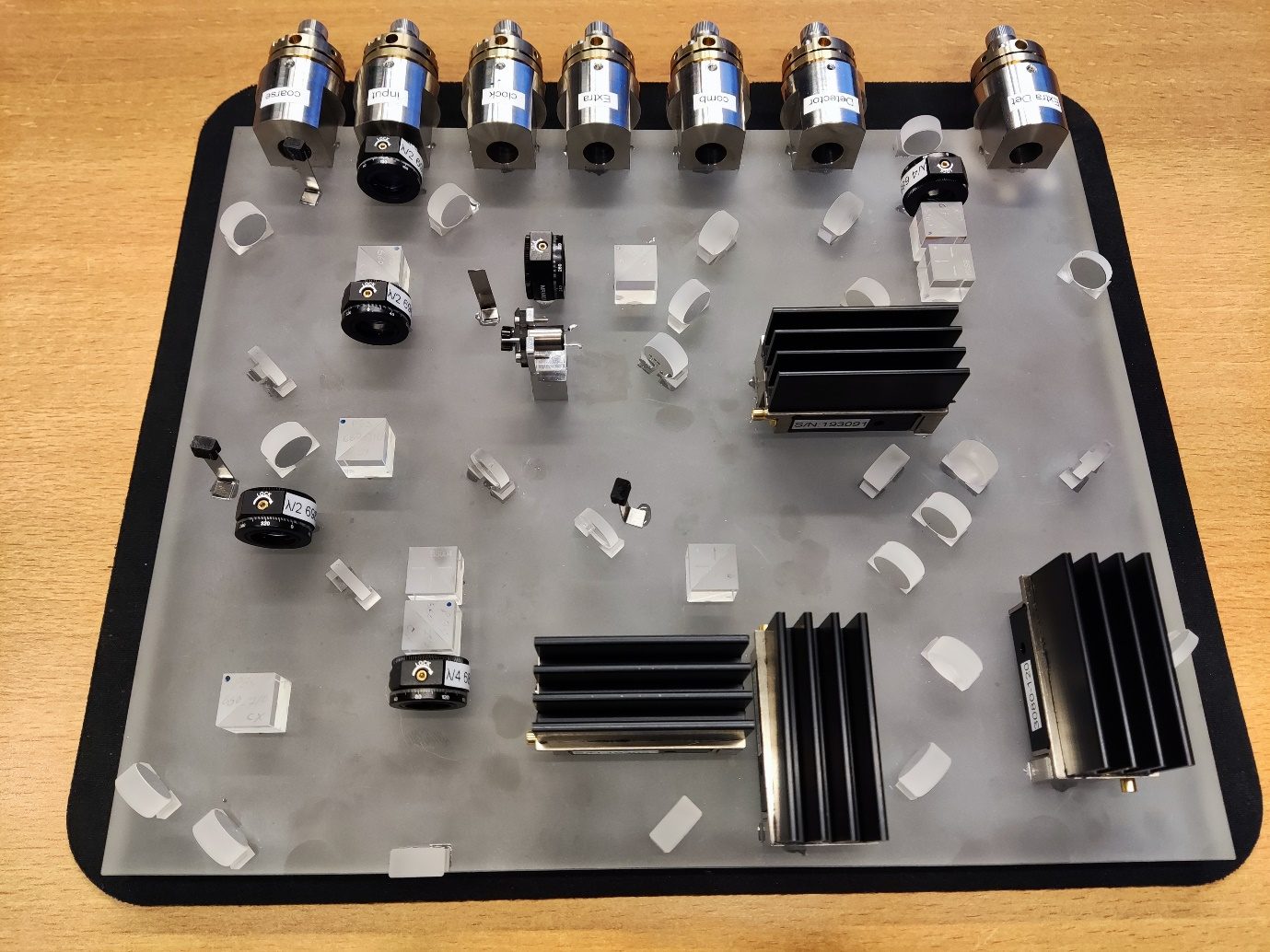
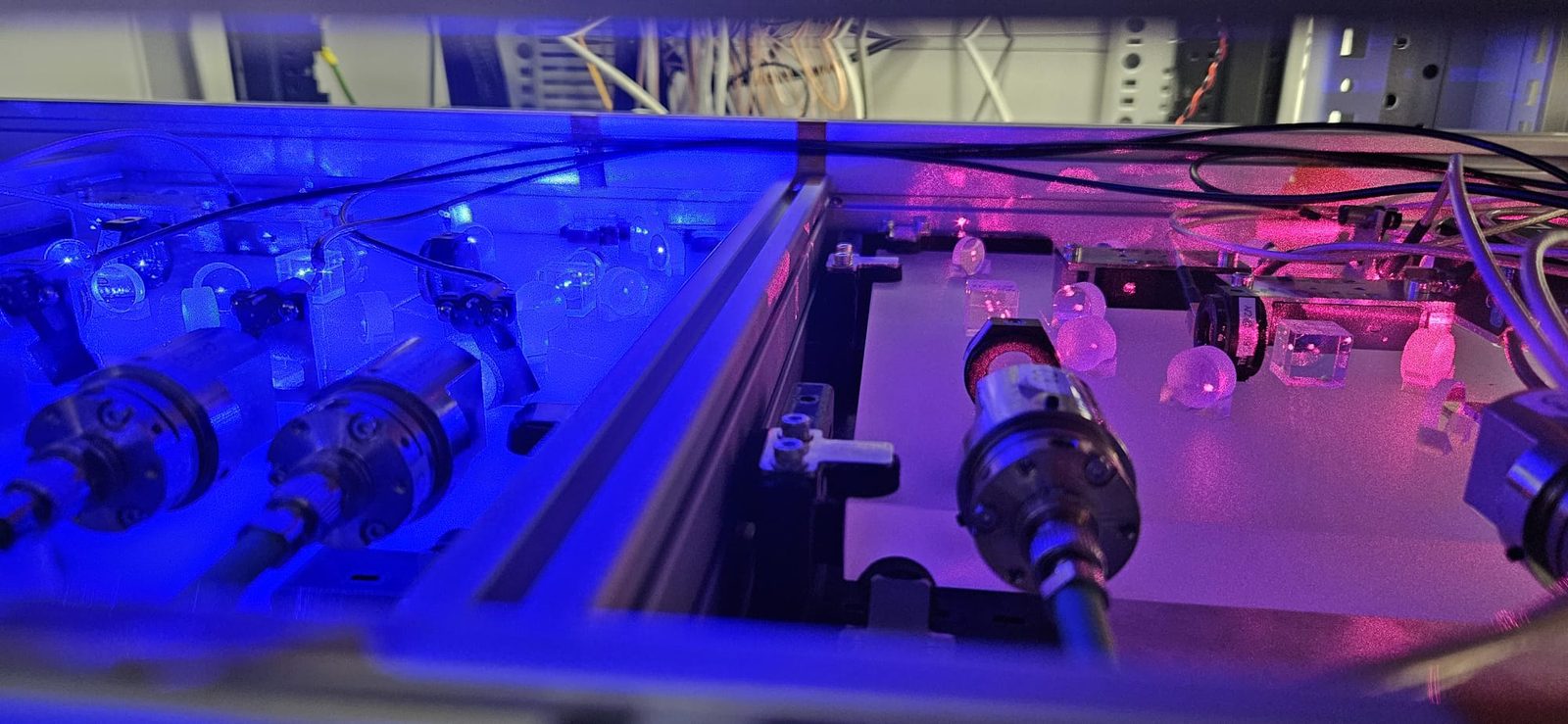
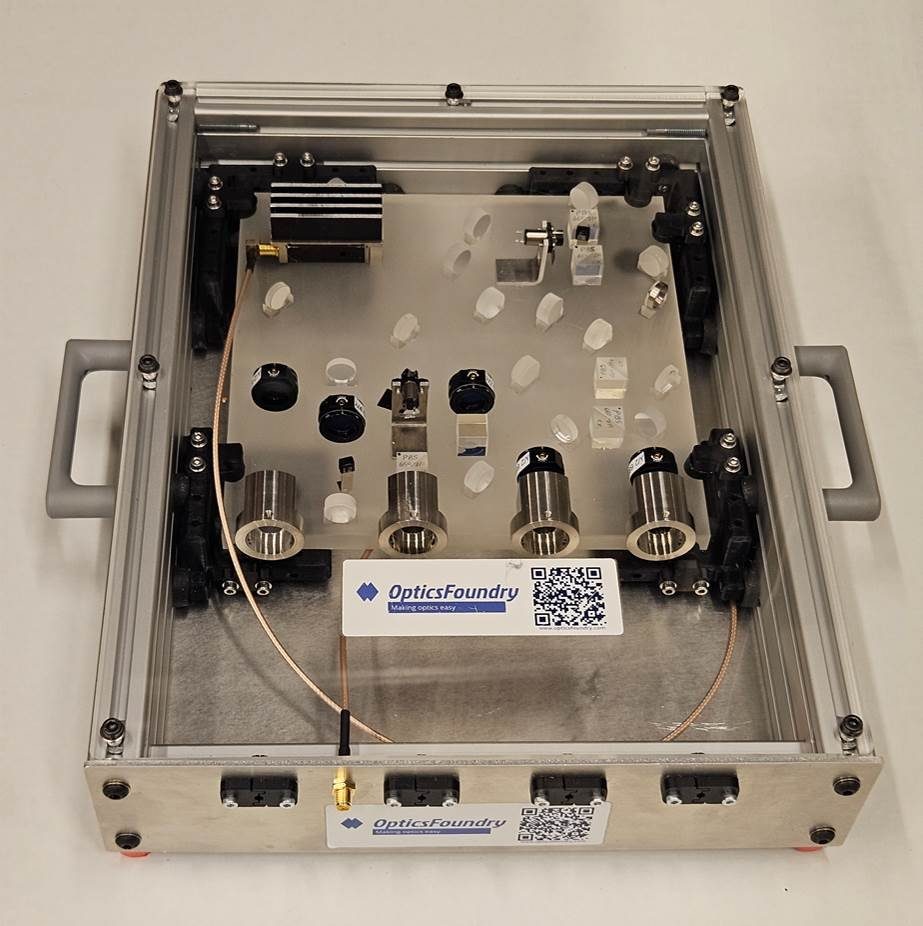
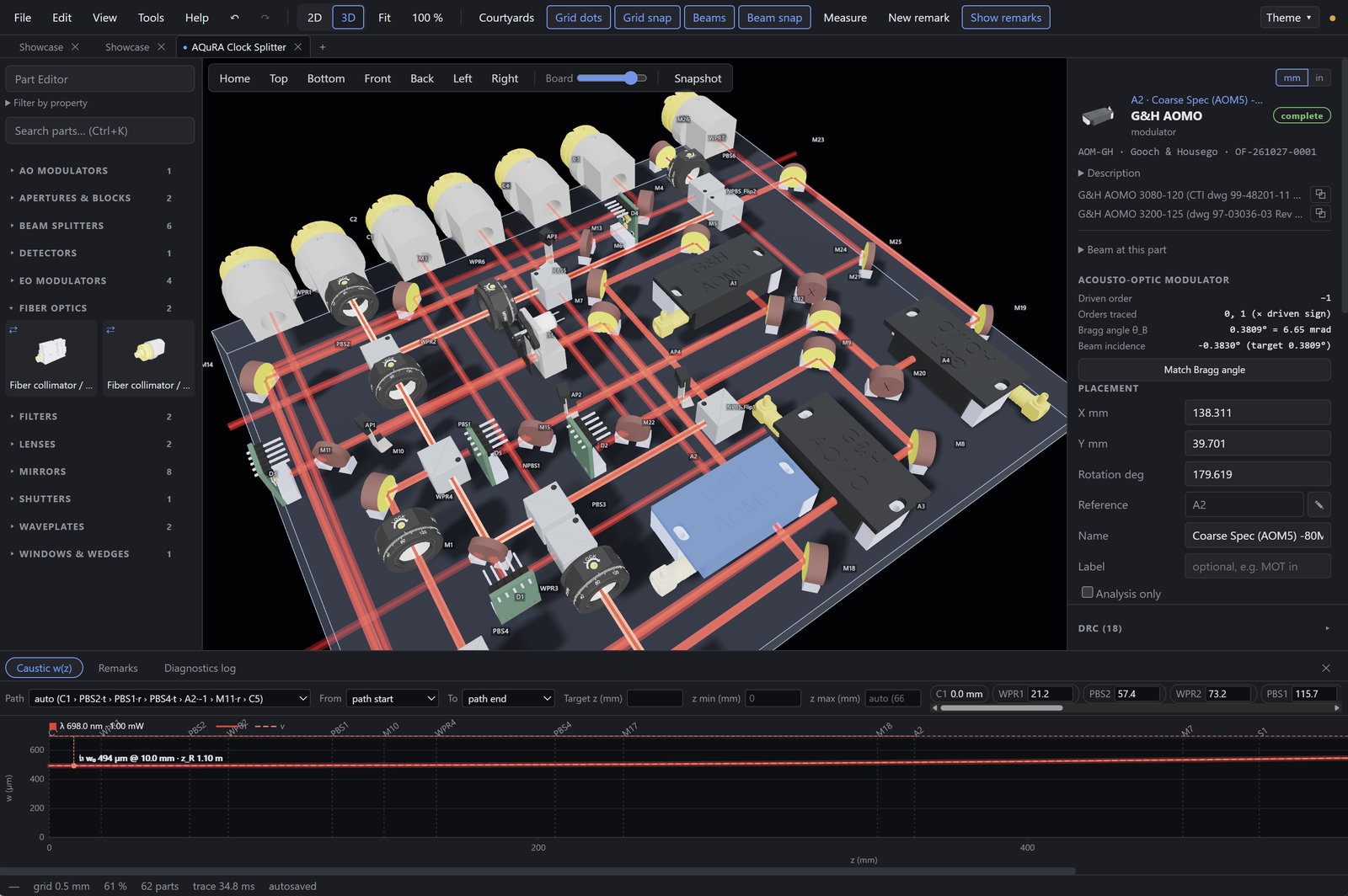
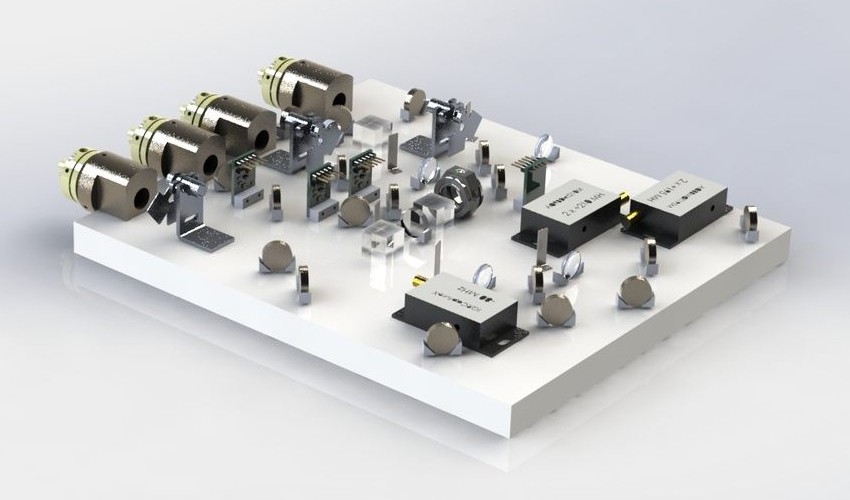
An OpticsFoundry board carries its optics, such as fiber couplers, acousto-optic and electro-optic modulators, waveplates, beam splitters and shutters, bonded onto a 15 mm thick glass baseplate. The optics are aligned by a robot while laser light at the operating wavelength runs through the board, and then fixed permanently. You connect fibers and RF at the edge, and the board does the rest: frequency shifting, switching, intensity control, and combining and distributing beams. The boards come in a vibration-damped frame or a 19-inch rack drawer, and they are built to stay aligned. Circuits are designed in OpticsFoundry Studio, a free design tool that runs in the browser, traces the laser beams through the design and checks whether the robot can assemble it.
Born in AQuRA
The first boards were developed for the EU Quantum Flagship project AQuRA, in which an industry consortium builds a transportable strontium optical clock. All the AQuRA work in our lab was done by the team that now runs OpticsFoundry, and the six boards for a full strontium lattice clock were its first complete set. OpticsFoundry was co-founded by Shayne Bennetts, an alumnus of our lab, and Florian Schreck.
A modern successor to our control system
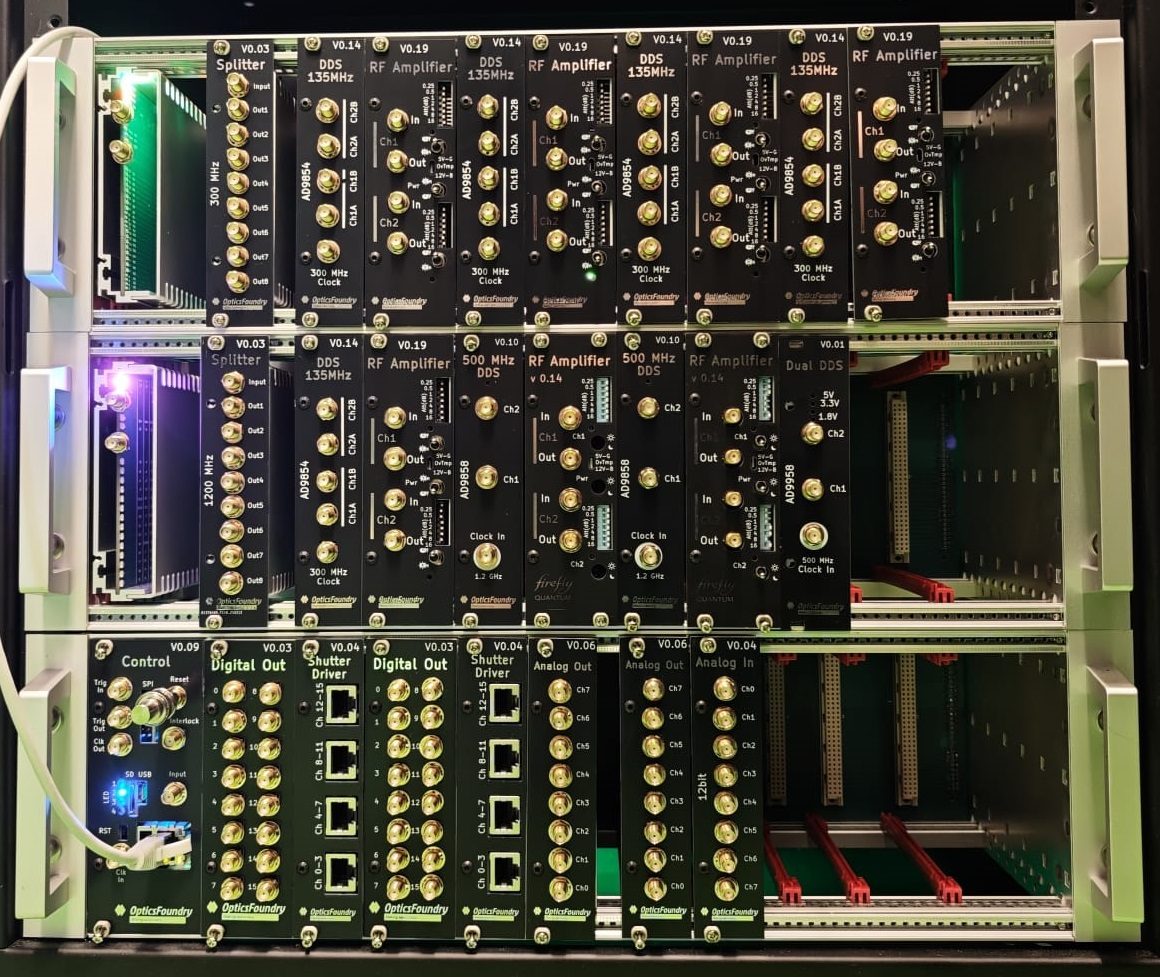
For many years our experiments have run on our home-built control system. Its modern successor is offered by OpticsFoundry: an Ethernet-connected FPGA sequencer with direct digital synthesizers, RF amplifiers, shutter drivers, and analog and digital inputs and outputs, together with open-source Python, C and C++ interfaces for Linux and Windows and an open-source graphical interface for experiment control. The same electronics drives the optical circuit boards in AQuRA.
In the lab
OpticsFoundry's lab, D0.138, is next door to our experiments, and the main person there is Mehrdad Zarei. His open-source Red Pitaya laser locking system is a good example of the spirit of the place: build a tool that solves a real problem in the lab, make it robust, and then share it. Students and researchers who are curious about the step from a physics idea to a product will find plenty to talk about here.
Gallery