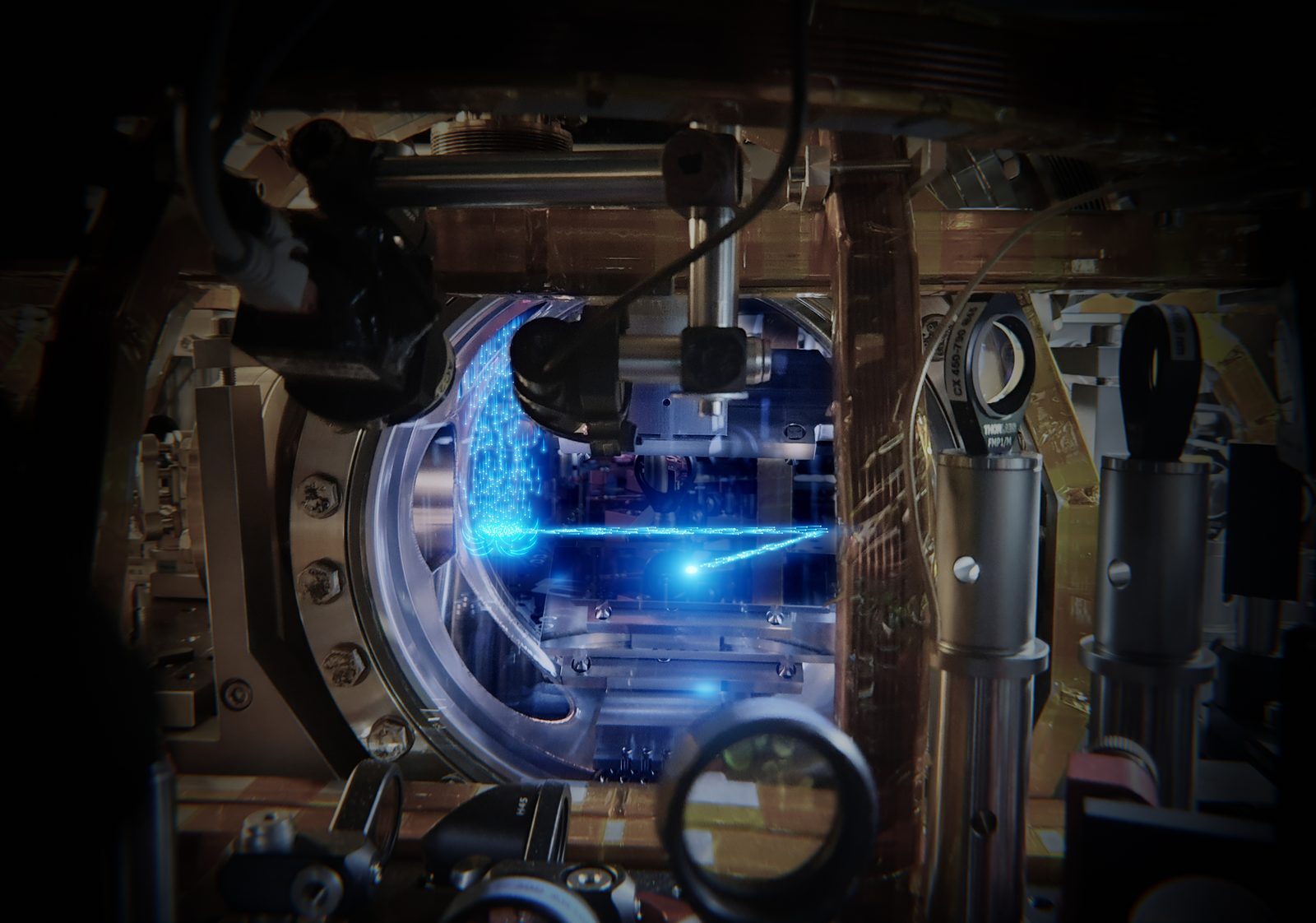
SrPAL
A Bose–Einstein condensate that never has to be switched off
Why a continuous atom laser?
An optical laser is a single light wave populated by many photons that all travel in the same direction with the same color. An atom laser is the matter-wave version: a propagating quantum wave of many atoms that all move with the same velocity. Until now, atom lasers have been outcoupled from Bose–Einstein condensates (BECs), and they only last until the condensate is used up. Making a new BEC takes seconds, because the two cooling stages needed, laser cooling and evaporative cooling, are performed one after the other. For precision measurements such as atom interferometry, a matter-wave source that runs all the time would be much better, in the same way that many optical interferometers rely on continuous-wave lasers.
Cooling in space instead of in time
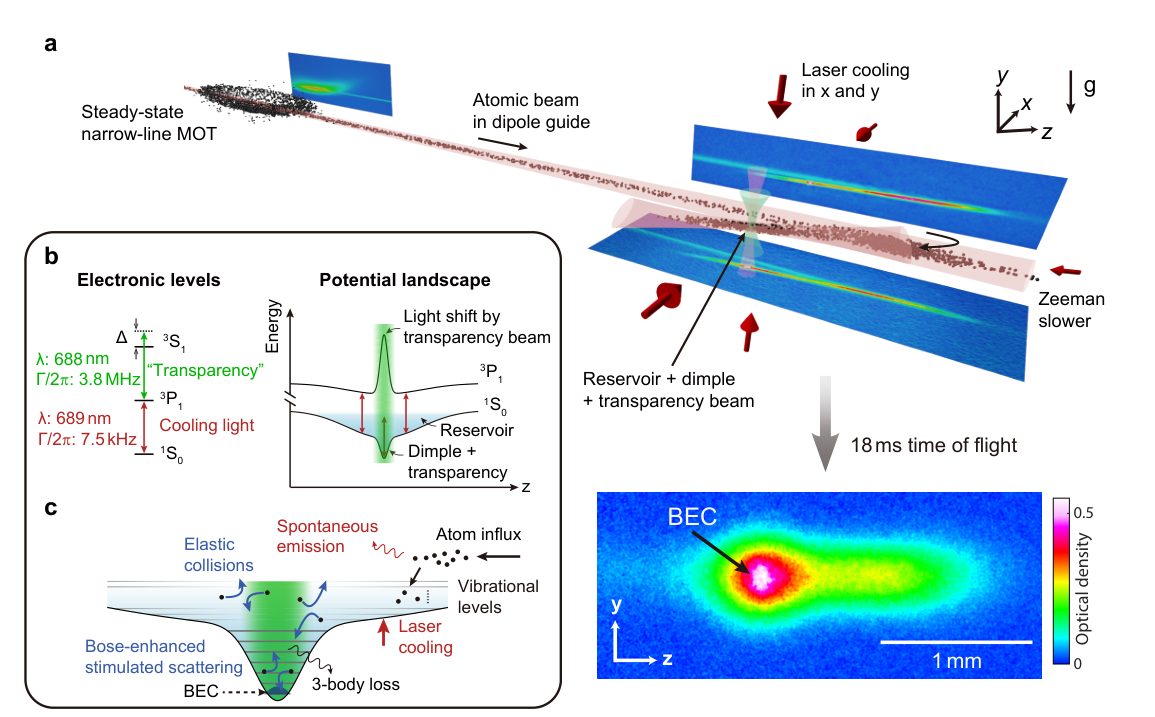
SrPAL's trick is to perform the cooling steps one after the other in space rather than in time. Strontium atoms leave an oven, are slowed and cooled on the broad blue transition in the upper part of the machine, and then flow, like marbles through an atomic marble run, into a region where only the narrow red transition (just 7.4 kHz wide) is used. Keeping the blue light physically separated is essential: near-resonant laser light destroys a BEC. The remaining red cooling light is made harmless by a “transparency” laser beam that shifts the atoms' energy levels so that, in the region where the condensate forms, they simply cannot absorb the cooling photons.
Along the way, the machine set several records: a steady-state magneto-optical trap with a 100-fold improved phase-space density, a continuously guided atomic beam with record phase-space density, and a new slowing scheme, the Sisyphus optical lattice decelerator.
A BEC that lives forever
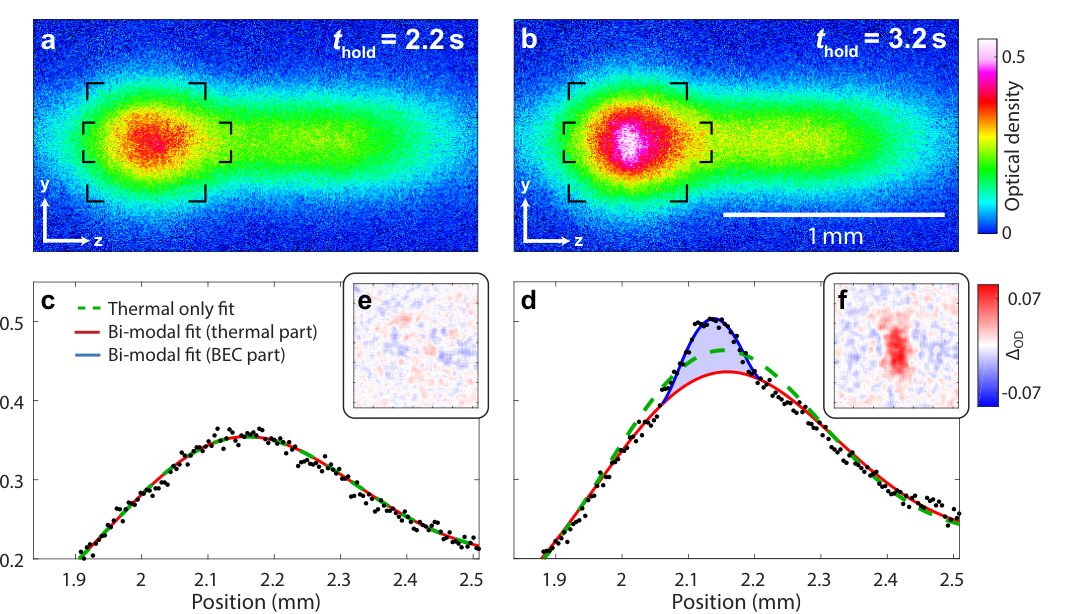
In 2022 the team demonstrated continuous Bose–Einstein condensation. Atoms of 84Sr from a steady-state narrow-line magneto-optical trap are guided into a large, laser-cooled “reservoir” trap containing a small, deep “dimple”. In the dimple, protected by the transparency beam, the density becomes high enough for a condensate to form. Bose-stimulated collisions keep scattering atoms into the condensate, providing the gain that balances its losses. The BEC can therefore be sustained indefinitely, far longer than the lifetime of any individual atom in the trap.
What's next
The missing step towards a continuous atom laser is a gentle, continuous outcoupling of atoms from the condensate. The plan, described in the most recent thesis, is to transfer condensed atoms with a multi-photon transition into the long-lived 3P0 state, which is not affected by the cooling light, and let them leave the trap as a coherent beam. Beyond atom lasers, the continuous ultracold sources developed on SrPAL are interesting for continuously operating superradiant lasers and clocks.
Working on SrPAL
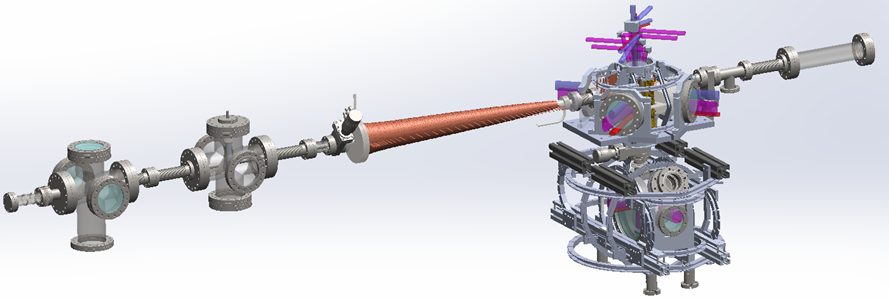
SrPAL is a large machine: an oven, a Zeeman slower, a large vacuum chamber, several laser systems (blue and red cooling lasers, repumpers, high-power infrared trapping lasers and narrow linewidth lasers), magnetic-field coils, and a computer control system that orchestrates it all. Earlier PhD students built the apparatus from an empty lab, designing the vacuum system, lasers and electronics themselves. Their theses, listed below, are an excellent introduction to building a steady-state quantum gas machine.
Gallery