RbSr
Two very different atoms, one quantum gas, and new molecules
A new kind of molecule
Molecules have a richer internal structure than atoms and interact in more intricate ways, which makes ultracold molecules attractive for quantum simulation, quantum chemistry and precision tests of fundamental physics. The ultracold molecules studied so far are mostly made of two alkali atoms. RbSr is different: an alkali atom (rubidium) bound to an alkaline-earth atom (strontium) leaves one unpaired electron. RbSr molecules therefore carry a magnetic dipole moment in addition to an electric one: two handles with which to control them and to engineer interesting few- and many-body systems.
Feshbach resonances that were not supposed to be there
The standard way to make ultracold molecules is to sweep a magnetic field across a Feshbach resonance. For a long time it was assumed that such resonances would not exist between an alkali atom and a closed-shell atom like strontium. Following a theoretical prediction, the RbSr team observed them for the first time in 2018. They turned out to be extremely narrow, typically below a milligauss wide, so using them requires very stable magnetic fields. The team therefore built a field stabilization that holds kilogauss fields stable at the ppm level, and characterized the Rb–Sr interaction potential through extensive spectroscopy. On the same machine, the team also produced long-lived Sr2 molecules from pairs of atoms in an optical lattice.
A good neighbor: measuring the g factor of 87Sr
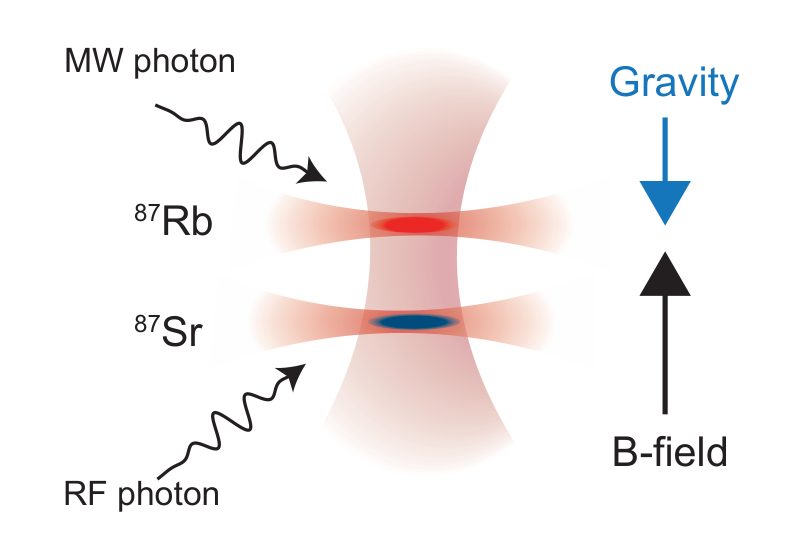
To get strong interactions, the team now works with a resonantly interacting Bose–Fermi mixture of 87Rb and 87Sr. Both gases are cooled in separate traps and then brought together, and confining the mixture to two dimensions strongly suppresses the three-body losses that usually limit such gases. The two co-trapped clouds also made a precision measurement possible: by driving nuclear magnetic resonance transitions in ground-state 87Sr while using the rubidium cloud nearby as an in-situ magnetometer, the team measured the nuclear g factor of 87Sr at the parts-per-million level, improving on previous values by more than two orders of magnitude. This number matters for optical clocks, quantum simulation and quantum computing with 87Sr.
What's next
The next goal is to create and detect weakly bound RbSr molecules using confinement-induced resonances, and then transfer them to more deeply bound states with laser pulses (STIRAP). A high-resolution microscope objective is ready to be installed, which will allow the team to study density correlations, and an optical lattice that traps Rb and Sr at different sites could create a unique lattice system of alkali and alkaline-earth atoms.
The machine and working on it
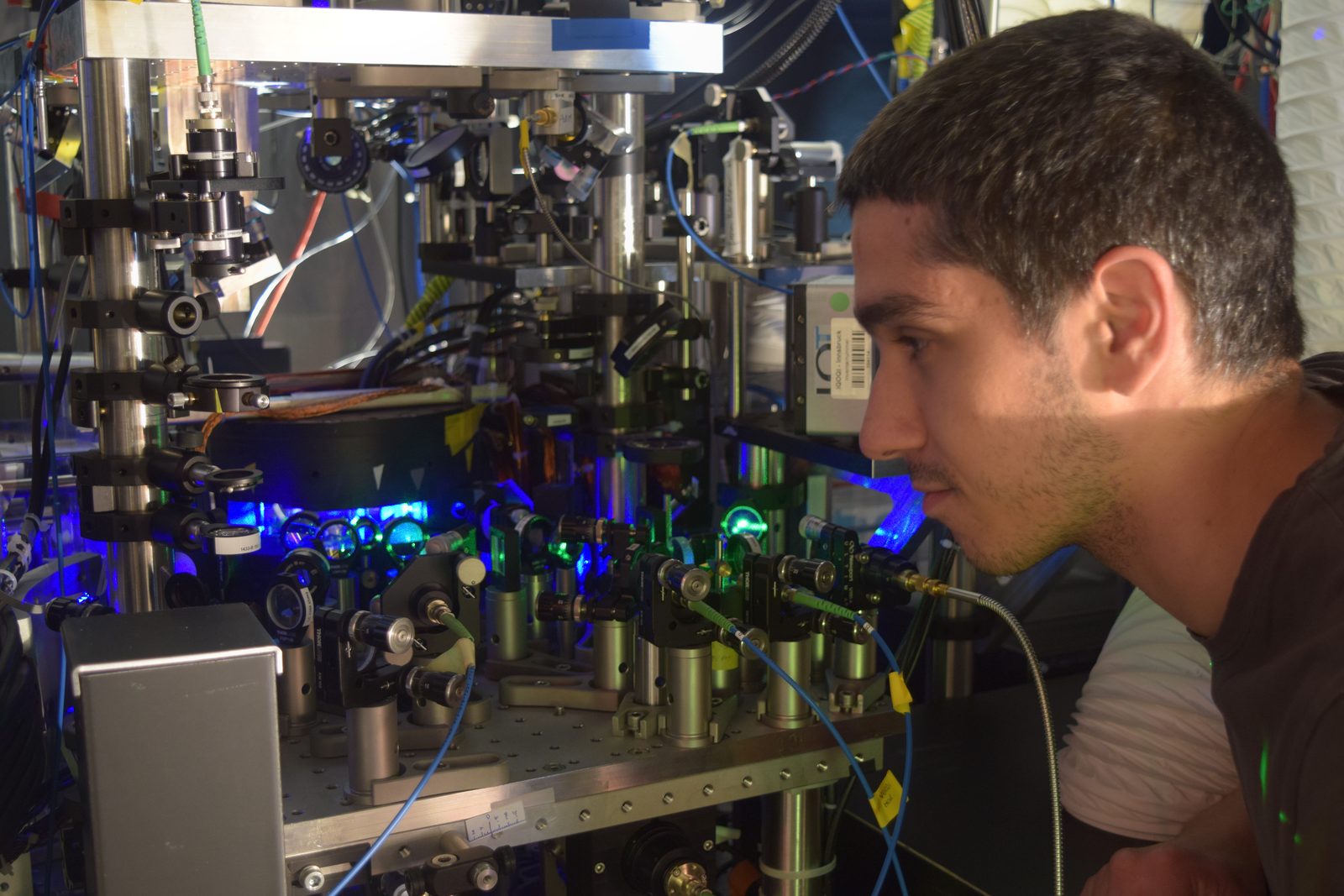
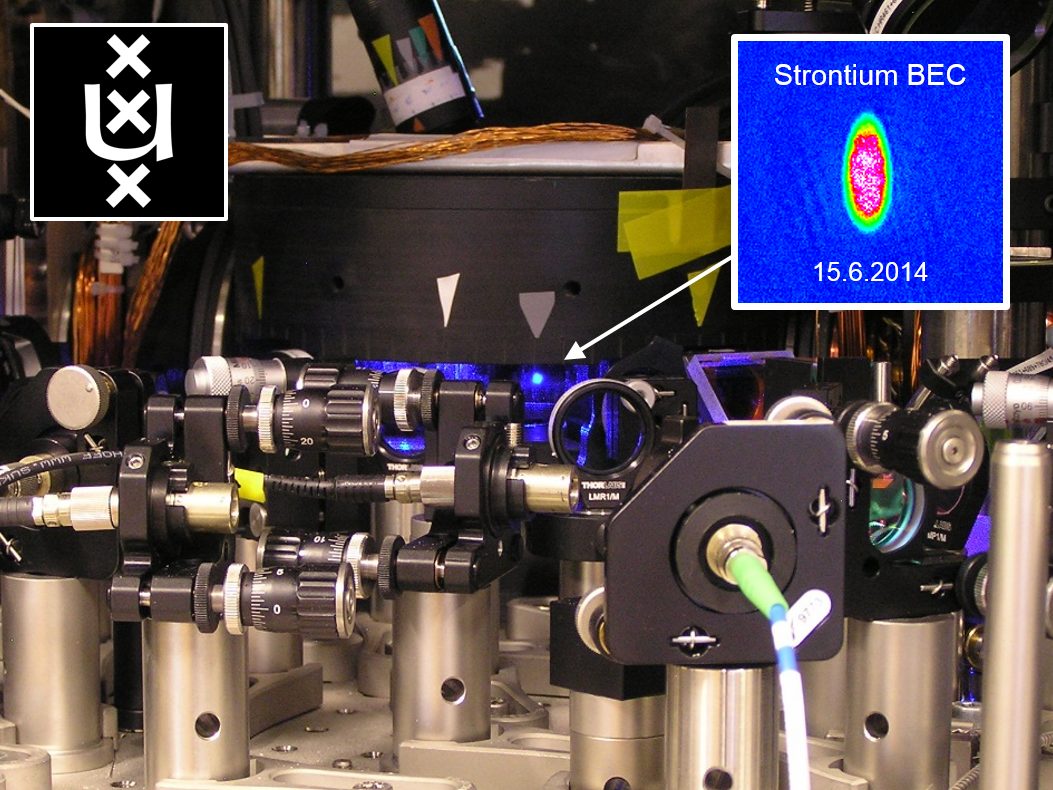
The RbSr apparatus has a long history: it was built in Innsbruck as the machine that produced the first strontium BEC (see SrBEC) and moved to Amsterdam in December 2013. Since then it has been rebuilt and extended several times. A PhD on RbSr means working with two atomic species and therefore many lasers, ultra-high vacuum, optical lattices, precision magnetic fields and plenty of electronics. Several home-built devices developed here, such as the magnetic-field stabilization and a high-power RF amplifier, have been released as open-source designs. Klaasjan van Druten and Florian Schreck lead the project together.
Gallery